A commercial kitchen can look perfectly clean on the outside and still have a hidden cleaning problem: limescale.
From school cafeterias and hotel kitchens to restaurants, canteens and food-service facilities, equipment that regularly uses or heats water can gradually develop mineral deposits. Kettles may develop white deposits, water heaters can collect scale and dishwashing equipment may need additional attention.
This is where descaling becomes an important part of kitchen care.
However, choosing a descaler is not simply about picking the strongest-looking cleaning product. The right solution should match the type of buildup, equipment, usage requirements and manufacturer recommendations. So, how do you choose the right descaler for a busy commercial kitchen?
What Is a Kitchen Descaler?
A descaler is a cleaning solution designed to remove mineral deposits or limescale that develop when hard water is repeatedly used or heated.
Unlike grease and food residue, limescale is not an oily or organic buildup. It is a mineral deposit that can gradually collect on water-contact surfaces.
This makes descaling different from everyday kitchen cleaning.
For example:
- A degreaser tackles grease and oily cooking residues.
- A dishwashing product is designed for cleaning dishes and utensils.
- A descaler targets mineral deposits associated with hard water.
Understanding this difference is the first step towards choosing the right product.
Why Does Commercial Kitchen Equipment Develop Limescale?
Hard water contains higher concentrations of dissolved minerals, particularly calcium and magnesium. When hard water is repeatedly heated or evaporates from surfaces, these minerals can contribute to scale deposits.
This can happen in equipment such as:
- Commercial dishwashing machines
- Steamers
- Water heaters
- Kettles
- Tea and coffee urns
In a school kitchen, for example, water-based equipment may be used throughout the day to support meal preparation and cleaning. Over time, even a small amount of buildup can become noticeable.
Why Choosing the Right Descaler Matters
Not every cleaning chemical is designed to remove limescale.
Using an unsuitable product can make cleaning less effective and may not be appropriate for the equipment or surface being treated. A professional kitchen therefore needs to consider the product’s intended application before starting the descaling process.
The right descaler should be selected based on:
- The type of equipment
- The level of scale buildup
- Product instructions
- Equipment recommendations
- Required dilution
- Suitable application areas
Selecting the appropriate product helps kitchen teams follow a more consistent and controlled cleaning process.
Things to Consider When Choosing a Commercial Descaler
1. Check Which Equipment the Product Is Designed For
The first question should always be: Where can the product be used?
A descaler intended for one application may not be suitable for every piece of kitchen equipment.
Look for a product that clearly identifies the equipment types it is designed for. This is especially important for commercial and institutional kitchens where several types of water-using equipment may be present.
2. Consider the Level of Limescale
Not every kitchen has the same level of buildup.
Some equipment may have light deposits, while heavily used equipment may develop more stubborn scale.
A suitable professional descaler should provide clear usage or dilution guidance for different levels of soiling. This allows kitchen staff to follow the recommendations rather than guessing how much product to use.
3. Look for Clear Usage Instructions
A professional cleaning product should be easy for trained kitchen staff to understand and use correctly.
Instructions should clearly explain important information such as:
- Recommended dilution
- Application method
- Contact time, where applicable
- Rinsing requirements
- Suitable equipment or surfaces
- Safety precautions
Clear instructions help reduce mistakes and encourage consistent cleaning practices.
4. Consider the Product Format and Quantity
Commercial kitchens often need cleaning products in larger quantities than a household kitchen.
For schools, hotels, cafeterias and food-service operations, a larger pack can be practical when the product is used regularly.
However, the right pack size depends on equipment usage, cleaning frequency and storage requirements.
5. Choose a Product Designed for Professional Kitchen Care
Professional environments have different cleaning demands from homes.
School kitchens, for example, may prepare meals for large numbers of students every day. Equipment can be used frequently, and cleaning routines need to fit around busy schedules.
Choosing professional cleaning products designed for specific commercial kitchen applications can help staff address specific cleaning requirements instead of relying on one general-purpose chemical for everything.
EMPERIA 1900 K-Pro Descaler for Professional Kitchen Care
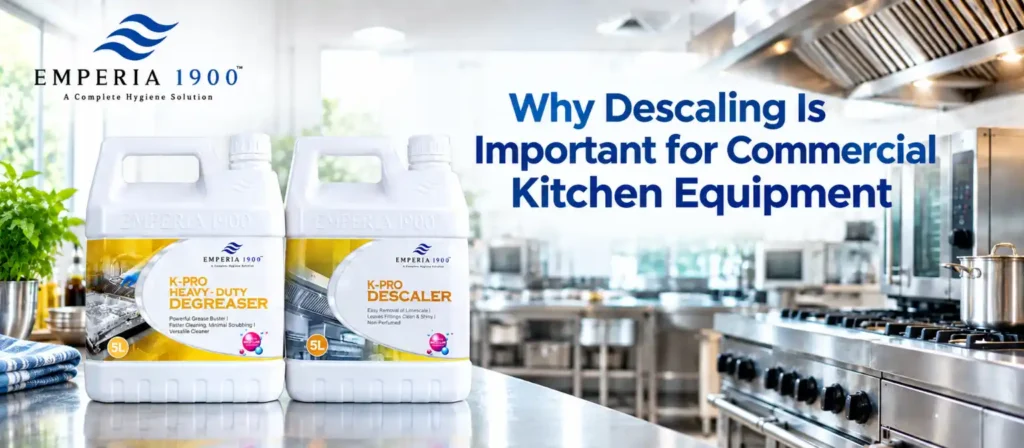
For commercial and institutional kitchens, EMPERIA 1900 K-Pro Descaler is a dedicated solution for removing limescale from suitable kitchen equipment.
It is a concentrated acidic cleaner suitable for dishwashing machines, steamers, water heaters, kettles and tea/coffee urns. Available in a 5-litre, non-perfumed pack, it also provides dilution guidance based on the level of soiling.
What Makes Descaler a Practical Kitchen-Care Option?
Designed for Limescale Removal
The primary purpose of descaler is to tackle mineral deposits rather than grease or food residue. This makes it suitable for a specific cleaning requirement that ordinary kitchen cleaners may not address effectively.
Suitable for Multiple Types of Equipment
One practical advantage is its listed application across several types of water-using kitchen equipment.
This includes:
- Dishwashing machines
- Steamers
- Water heaters
- Kettles
- Tea and coffee urns
Having one dedicated solution for multiple suitable applications can simplify product selection and kitchen maintenance.
Concentrated Formula
Descaler is a concentrated product, with dilution guidance provided according to the level of soiling. This gives professional users a structured way to prepare the product rather than relying on guesswork.
5-Litre Pack for Professional Use
Commercial kitchens can have demanding cleaning schedules. A 5-litre pack provides a practical format for facilities that regularly need to manage limescale.
The appropriate quantity and usage frequency will naturally depend on the facility, equipment and maintenance schedule.
How to Use a Commercial Descaler Correctly
Choosing the right product is only part of the process. Correct use is equally important.
A basic approach includes:
Step 1: Identify the equipment and confirm the descaler is suitable for it.
Step 2: Check the product instructions and equipment recommendations before use.
Step 3: Prepare the solution using the recommended dilution.
Step 4: Apply the descaler as directed and allow it to work as instructed.
Step 5: Rinse the equipment thoroughly to remove product and loosened deposits.
Step 6: Return the equipment to service only after cleaning and rinsing are complete.
Descaler vs Grease Cleaner: Which One Do You Need?
This is one of the most common questions in commercial kitchen cleaning.
The answer depends on the type of dirt.
Limescale? Choose a descaler. Grease and oil? Choose a degreaser.
For example, a school kitchen may use a descaler for its water heater and dishwasher while using a degreaser on cooking surfaces and equipment exposed to oil.
Using a product according to the type of buildup helps kitchen staff avoid unnecessary chemical use and makes cleaning more targeted.
Why Schools Need a Planned Kitchen-Care Routine
Commercial kitchens need regular maintenance to support effective cleaning and smooth daily operations.
- Daily Checks: Look for dirt, food residue, grease and unusual deposits.
- Equipment Inspection: Check water-using equipment for white or chalky mineral buildup.
- Scheduled Descaling: Descale based on water hardness, usage, buildup and recommendations.
- Record Maintenance: Track cleaning and descaling tasks to prevent missed maintenance and recurring issues.
This approach is more effective than waiting until equipment develops significant buildup.
Common Mistakes to Avoid When Descaling
- Using a general-purpose
- Using Too Much Product
- Ignoring Equipment Instructions
- Skipping the Rinse
- Waiting Until Scale Becomes Heavy
Why the Right Kitchen-Care Products Make a Difference
A professional kitchen has many different cleaning challenges. Grease, food residue, mineral deposits, stains and hygiene concerns cannot always be handled with one product.
That is why a structured kitchen-care programme should include products selected for specific cleaning needs.
EMPERIA 1900’s Kitchen Care range focuses on descaling, degreasing and dishwashing, allowing professional facilities to approach different kitchen-cleaning requirements with dedicated solutions.
For facilities such as schools, hotels, food-service operations and institutional kitchens, this can support a more organised approach to routine cleaning and equipment care.
Final Thoughts
Choosing the right descaler is not simply about finding a product that removes white deposits. It is about selecting a solution that matches the equipment, level of buildup and cleaning requirements of the facility.
For busy kitchens, especially those in schools and other institutions, regular equipment care can help maintain smoother day-to-day operations.
EMPERIA 1900 K-Pro Descaler offers a dedicated solution for limescale removal on suitable kitchen equipment, including dishwashing machines, steamers, water heaters, kettles and tea or coffee urns.
When used according to the product instructions and equipment recommendations, it can become a useful part of a broader kitchen-care routine.
FAQs:
1. What is the best descaler for commercial kitchen equipment?
The best descaler depends on the equipment, level of limescale and recommendations. A professional solution such as EMPERIA 1900 K-Pro Descaler is designed to remove limescale from suitable commercial kitchen equipment.
2. How do you remove limescale from commercial kitchen equipment?
Limescale can be removed using a suitable commercial descaling solution. First, check the equipment instructions, prepare the descaler as directed, allow it to work as specified, and rinse the equipment thoroughly before use.
3. How often should commercial kitchen equipment be descaled?
Commercial kitchen equipment should be descaled based on water hardness, equipment usage, visible limescale buildup and recommendations. Frequently used equipment such as dishwashers, steamers and water heaters may require more regular attention.
4. What is the difference between a descaler and a degreaser?
A descaler removes mineral deposits caused by hard water, while a degreaser removes grease, oil and cooking residues. Commercial kitchens often need both because limescale and grease require different cleaning solutions.
5. Which commercial kitchen equipment needs descaling?
Equipment that regularly uses or heats hard water commonly needs descaling. This includes commercial dishwashing machines, steamers, water heaters, kettles and tea or coffee urns where mineral deposits can gradually accumulate.