![EMPERIA 1900_WEBSITE_BANNERS_SIZE - 1600px X 700 px_01_[A]-09](https://emperia1900.com/wp-content/uploads/2026/02/EMPERIA-1900_WEBSITE_BANNERS_SIZE-1600px-X-700-px_01_A-09.jpg-768x336.jpeg)
Choosing cleaning products for a commercial facility is not as simple as picking the cheapest option or using whatever the housekeeping team has always used. Businesses must also consider product performance, staff safety, resource consumption and environmental responsibility; choosing between traditional and eco-friendly solutions requires consideration of the facility’s actual operational needs.
But does choosing an eco-friendly option mean giving up performance? Are traditional products always more affordable? The answer depends on how each product performs in real working conditions and whether it meets the facility’s specific cleaning and operational requirements.
What Are Traditional Cleaning Products?
Traditional cleaning products have been used across commercial facilities for many years. They are available in different formulations for tasks such as removing grease, stains, deposits, dirt and other types of soiling.
Their familiarity is one of their biggest advantages. Housekeeping teams may already know how to use them, and businesses may have established purchasing routines around these products.
However, familiarity should not be confused with suitability.
A product that has been used for years may still require excessive quantities, frequent applications or specific handling procedures. For this reason, businesses should regularly review whether their existing products continue to meet their cleaning, surface-care, and operational needs.
What Are Eco-Friendly Cleaning Products?
Eco-friendly cleaning products are developed with greater consideration for environmental impact, product use, and the requirements of people and surfaces.
This can involve the ingredients, product efficiency, packaging or the way a solution is used. However, the term should not be treated as a guarantee that a product is automatically suitable for every facility or application.
For commercial users, the more important question is simple:
Does the product provide the required result while supporting more responsible day-to-day practices?
That is where a practical comparison becomes useful.
Eco-Friendly vs Traditional Cleaning Products: Key Differences
Comparison Area | Traditional Cleaning Products | Eco-Friendly Cleaning Products |
1. Ingredients and Formulation | Traditional products use established formulations designed to handle specific cleaning challenges. They may be suitable for demanding cleaning applications. | Eco-friendly products place greater emphasis on reducing environmental impact while maintaining effective cleaning performance. |
2. Performance | Traditional products can be effective for specific cleaning tasks and may already be familiar to housekeeping teams. | Eco-friendly products can also deliver effective and consistent results when selected for the correct application. |
3. Product Usage | Excessive use can increase consumption, create residue and require additional cleaning work. | Eco-friendly products should be used according to the recommended quantity and application method to avoid wastage. |
4. Impact on Surfaces | Traditional products may be formulated for specific surfaces, including floors, washrooms, kitchens, glass and equipment. | Eco-friendly products are not automatically suitable for every surface or application. Surface compatibility should always be checked. |
5. Cost | A lower purchase price may not always mean a lower overall cost if the product requires larger quantities or repeated applications. | An eco-friendly product with a higher initial price may offer better overall value if its usage, performance, and application requirements justify the cost. |
Are Eco-Friendly Products More Expensive?
Eco-friendly cleaning products may have different price points depending on the formulation, concentration, pack size, and application.
The overall cost depends on the product, concentration, pack size, application and usage method.
Instead of comparing only the price of two containers, facility managers should consider how much product is required for the intended task and how efficiently it performs. Bulk purchasing may reduce the unit cost in some cases, but facilities should also consider storage capacity, consumption rate, and inventory requirements.
When a product provides consistent results with efficient usage, its overall value can extend beyond the initial purchase price.
Are Traditional Products Still a Good Choice?
They can be, depending on the application.
Traditional products are not automatically unsuitable simply because newer eco-friendly options are available. Some facilities may still require particular solutions for specific tasks.
The important point is to avoid choosing a product purely because it is familiar.
Businesses should periodically review their current product range and ask whether each solution is still delivering the required performance, value and ease of use.
What About Staff Safety and User Experience?
The product used by housekeeping teams affects their everyday working environment.
Strong odours, incorrect application and poor handling practices can make routine tasks less comfortable. Clear instructions and appropriate product selection can help teams work follow cleaning procedures more consistently.
This does not mean every traditional product creates a safety problem or every eco-friendly product is risk-free.
Regardless of product type, staff should read the instructions, follow recommended usage and use appropriate protective measures where required.
A Practical Example from EMPERIA 1900
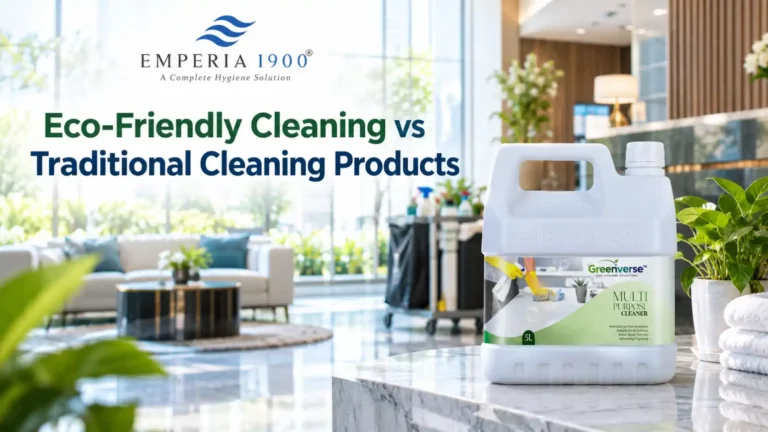
EMPERIA 1900 provides professional cleaning solutions for hotels, healthcare facilities, educational spaces, offices, food service businesses, retail environments and facility management teams. Alongside its product range, the company offers training and support to help housekeeping teams use its solutions effectively. For example: Greenverse Multi Purpose Cleaner, an eco-safe product from the Greenverse range designed for a variety of cleaning applications.
For businesses considering a move towards more responsible product choices, an option such as this can be evaluated according to the facility’s actual requirements rather than simply choosing a product because it carries an environmental message.
How to Choose the Right Option for Your Business
There is no universal answer to the question of which category is better.
Instead, consider these five questions:
What does the facility need?
Identify the areas, surfaces and types of soiling your team deals with regularly.
How often will the product be used?
High-frequency applications require careful attention to product consumption and overall value.
What does the supplier recommend?
A reliable supplier should provide clear information about application, quantity or dilution where applicable, surface suitability, and handling.
How does the product perform in real conditions?
Trialling a suitable solution in a controlled area can provide more useful information than relying only on marketing claims.
Does it support your wider business goals?
If your organisation has sustainability targets, employee wellbeing priorities or resource-saving goals, product selection can form part of that larger strategy.
Should You Switch From Traditional to Eco-Friendly Products?
You do not need to replace everything at once. Start by testing an eco-friendly product in one suitable area, then compare its cleaning performance, product usage, ease of use, and staff feedback with your current product.
If it delivers reliable results, gradually introduce it elsewhere. This reduces disruption while supporting more sustainable cleaning practices and potential cost savings.
Final Thoughts
The choice between eco-friendly and traditional cleaning products depends on your facility’s needs. Consider performance, cost, product usage, surface suitability, staff requirements and environmental impact.
EMPERIA 1900 offers professional solutions and support to help businesses evaluate and select suitable hygiene products for their operational requirements.
FAQs
1. Do eco-friendly cleaning products work as well as traditional products?
Yes, suitable eco-friendly products can deliver reliable results when selected for the correct application. Performance depends on the product, surface, level of soiling and correct usage rather than whether the solution is labelled traditional or eco-friendly.
2. Is switching to eco-friendly products difficult for housekeeping teams?
The transition can be straightforward when staff receive clear instructions. Teams may need guidance about application, quantity or dilution where applicable, and suitable surfaces, but introducing products gradually can make the change easier to manage.
3. Can eco-friendly products reduce a company’s overall cleaning costs?
They can, depending on product usage, performance and application. Businesses should compare cost per use rather than purchase price alone, while also considering labour time, wastage, storage and frequency of reordering.
4. How should a hotel choose between traditional and eco-friendly products?
Hotels should consider guest expectations, staff requirements, surface types, product performance, usage and overall cost. The best option is one that supports consistent housekeeping standards while fitting the property’s operational and sustainability priorities.
5. What should facility managers ask a cleaning product supplier?
Ask about intended applications, surface compatibility, recommended quantities or dilution where applicable, handling instructions, product performance, staff training and ongoing support. These questions can help facility managers select solutions based on practical requirements rather than marketing claims.